When it comes to expansive outdoor projects—lighting up a 100-foot perimeter fence, outlining a massive estate roofline, or illuminating a long driveway—the challenge isn’t just about choosing the right color. It’s about physics. Many DIY enthusiasts and even some contractors fall into the same trap: they connect a high-quality LED strip, extend it too far, and find that the last few yards are significantly dimmer than the beginning.
This phenomenon is known as “Voltage Drop.” In large-scale installations, it is the difference between a professional-looking project and a failed one. Finding the best LED lights for outside is only the first step; the second is planning the electrical architecture to support them. In this guide, we will explore the technicalities of 24V waterproof LED strips, wire gauges, and power injection strategies for flawless long-run lighting.
What is Voltage Drop and Why Does it Happen?
Voltage drop is the gradual decrease in electrical voltage as it travels through a conductor (the copper inside your LED strip or extension wire). Because copper has a natural electrical resistance, some of the energy is converted into heat rather than light.
The Visual Impact
In an LED strip, voltage drop manifests as a loss of brightness or even a color shift at the end of the run. For example, a warm white strip might look slightly orange or pinkish at the tail end because the lower voltage isn’t enough to fully power the LED chips.
The Factors that Increase Drop
- Distance: The longer the wire or strip, the more resistance the electricity faces.
- Current (Amperage): High-power strips (more LEDs per meter) pull more current, which increases the drop.
- Voltage: Lower voltage systems (12V) are much more susceptible to drop than higher voltage systems (24V).
12V vs. 24V: The Secret to Long Distance
One of the most effective ways to combat voltage drop in large projects is to choose the right starting voltage. While 12V is common for small, indoor tasks, the best LED lights for outside in commercial or large-scale residential settings are almost always 24V waterproof LED strips.
Why 24V is Superior
Without getting too deep into Ohm’s Law (V = I × R), a 24V system can deliver the same amount of power as a 12V system using only half the current (amperage). Because resistance is constant, cutting the current in half results in significantly less heat and less voltage loss over the same distance.
- 12V Maximum Run: Typically 5 meters (16 feet) before noticeable dimming.
- 24V Maximum Run: Can often reach 10 meters (33 feet) or more from a single power feed.
Planning Your Power Strategy: Series vs. Parallel
In large projects, the way you connect your strips to the power supply is critical.
The Mistake: Daisy-Chaining (Series)
Many people connect one strip to the end of another. This forces all the current for all the strips to pass through the very first few inches of the first strip. This creates excessive heat and a dramatic voltage drop. It can even damage the PCB (Printed Circuit Board) of the first strip.
The Solution: Parallel Wiring
Instead of one long chain, run “home runs” of wire from your power supply to each individual 5-meter or 10-meter section. By feeding each section directly, every strip receives fresh, full voltage from the source.
The Pro Technique: Power Injection
If you absolutely must have a continuous, uninterrupted line of light longer than 10 meters, you use “Power Injection.” This involves running a separate, thicker gauge wire alongside the LED strip and “injecting” power at both ends of the strip, or even in the middle. This ensures the 24V waterproof LED strips maintain 100% brightness from start to finish.
See also: Why You Require a Home Safety Plan
Selecting the Correct Wire Gauge (AWG)
When running power across a yard or around a large building, the wire connecting your transformer to your LEDs matters just as much as the LEDs themselves.
Understanding AWG
AWG stands for American Wire Gauge. In this system, a lower number means a thicker wire.
- 22 AWG: Thin, only suitable for very short distances (less than 5 feet).
- 18 AWG: Standard for small outdoor projects.
- 14 AWG or 12 AWG: Necessary for long “main lines” that travel 30–50 feet through the garden.
The Calculation
If you are running a 24V system and your power supply is 40 feet away from the start of your LEDs, using a thin wire will cause the voltage to drop before it even reaches the first LED. To find the best LED lights for outside results, professional installers use voltage drop calculators to select a wire thick enough to keep the loss under 3%.
Outdoor Power Supplies: The Brain of the System
In a large outdoor project, your power supply (driver) is the most vulnerable point. It must be powerful enough to handle the total wattage and rugged enough to survive the environment.
Wattage Overhead
Never load a power supply to 100% capacity. This is known as the “80% Rule.” If your total run of 24V waterproof LED strips consumes 80 watts of power, use at least a 100-watt power supply. This prevents overheating and extends the life of the driver.
Weatherproofing the Driver
Even if your power supply is rated for “outdoor use,” it shouldn’t be buried in the mud.
- NEMA Enclosures: Mount your drivers in a ventilated, weatherproof box.
- Heat Dissipation: Large drivers generate heat. Ensure there is enough airflow around the box so the internal temperature doesn’t spike during hot summer days.
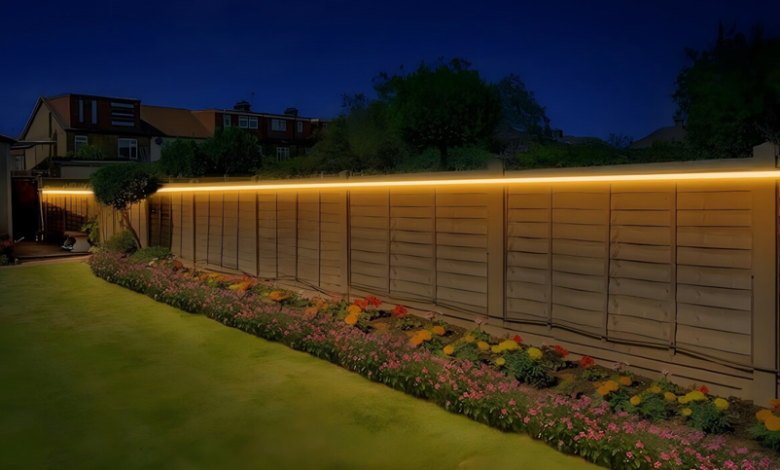
Real-World Case Study: Lighting a 150-Foot Fence
Imagine you want to light a 150-foot (approx. 45 meters) fence with a continuous line of 24V waterproof LED strips.
The Wrong Way:
Connecting nine 5-meter strips in a single line. The first strip will be hot and bright; the last strip will be almost invisible.
The Professional Way:
- Place a large 24V power supply at the midpoint of the fence.
- Run two “trunk lines” (thicker 14 AWG wire) in both directions from the center.
- Every 5 meters, tap into that trunk line to feed a new section of LED strip.
The result? A perfectly uniform line of light where the 1st foot looks identical to the 150th foot.
Conclusion: Engineering the Glow
Large-scale outdoor lighting is a marriage of art and engineering. While the best LED lights for outside provide the beauty, your planning provides the reliability. By choosing 24V waterproof LED strips, utilizing parallel wiring, and respecting the physics of voltage drop, you can create breathtaking, professional-grade lighting that stands the test of time and distance.
Don’t let your project fade into the shadows. Plan your power, calculate your runs, and watch your outdoor space transform with a consistent, brilliant glow.